
You don’t need a perfect routine. You need a plan for the days when everything goes wrong.
We’ve all had those days.
You wake up late, skip your morning routine, fall behind on your study schedule, and spend the rest of the day feeling guilty about everything you haven’t done. By evening, you’ve convinced yourself that the day is wasted. You’ll start fresh tomorrow, follow your routine properly, and finally get back on track. But tomorrow comes with its own problems.
BTW, I have a PACE habit tracker worksheet for you to download below!
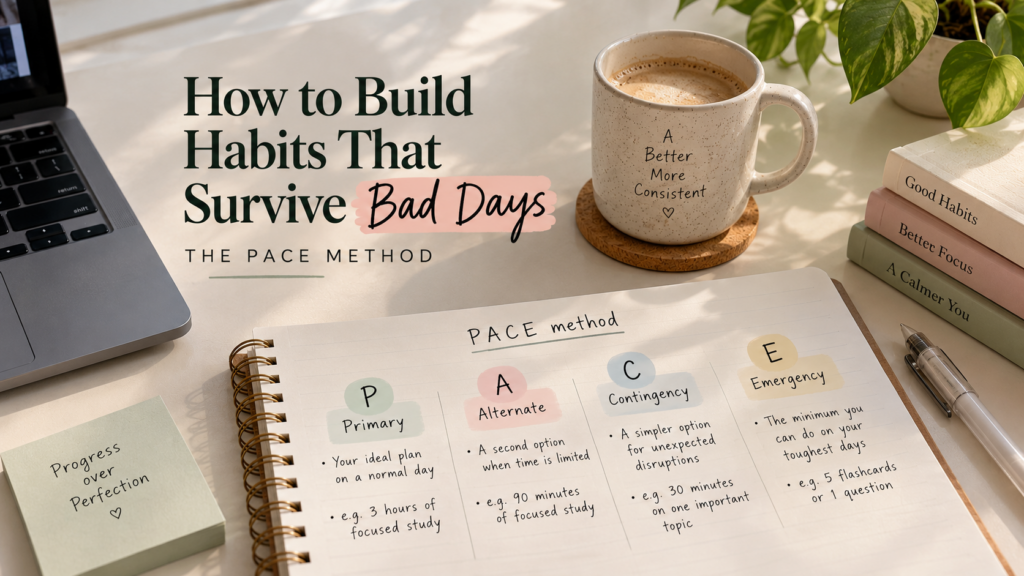
Maybe you slept poorly. Maybe you have an unexpected assignment, a difficult exam, a long day at college, or simply no motivation to do anything. And just like that, another day passes without you following through on the habits you promised yourself you’d build.
The problem isn’t necessarily your discipline. It might be your system.
Most habit-building advice focuses on what to do on your best days. Wake up early, exercise, read, study for three hours, journal, and repeat. But what happens when you don’t have the time, energy, or mental capacity to do all of that?
This is where an interesting military concept called PACE planning comes in.
Originally used to plan reliable communication systems, PACE stands for Primary, Alternate, Contingency, and Emergency. The idea is simple: instead of relying on one plan, you prepare multiple alternatives in case your preferred option fails.
And this concept can completely change the way you approach habits.
What is the PACE Method?
In military planning, relying on a single communication channel can be risky. If that channel becomes unavailable, there needs to be another way to communicate.
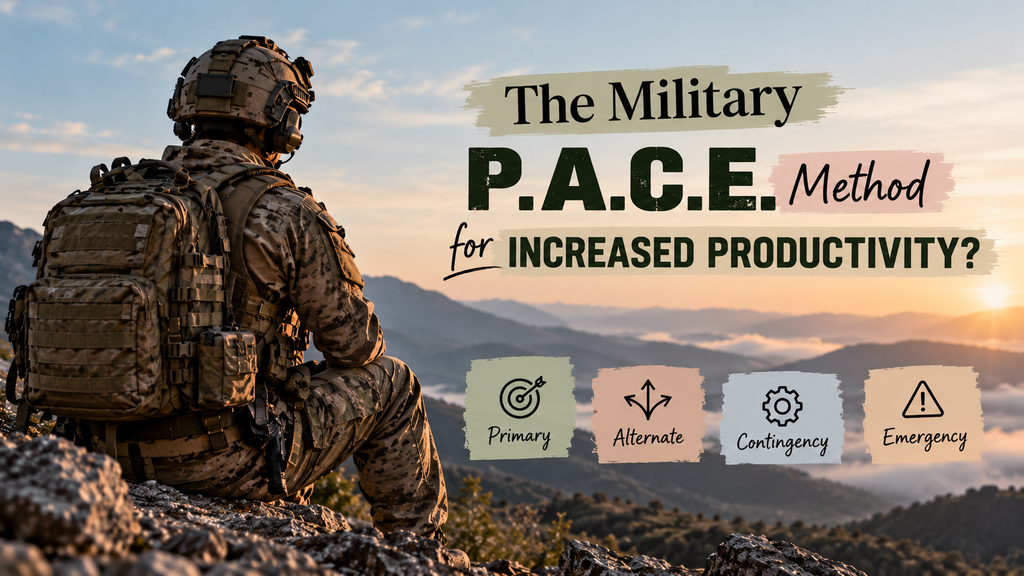
PACE planning addresses this by establishing four levels of backup.
- (P) Primary: Your preferred plan under normal circumstances.
- (A) Alternate: Your second option if the primary plan becomes unavailable.
- (C) Contingency: Another workable option if both the primary and alternate plans fail.
- (E) Emergency: The simplest fallback that allows you to preserve the most essential function.
The same logic applies to your everyday habits. Imagine your goal is to study consistently for an upcoming exam. Your ideal plan might involve three focused hours every evening. But what happens when a college event, an unexpected deadline, or sheer exhaustion makes that impossible?
Without a backup plan, you might skip studying altogether. With PACE, you already know what to do next. Instead of asking, “Can I follow my routine today?”, you ask, “Which version of my routine can I realistically follow today?”
Build Your Own PACE Plan for Every Important Habit
Let’s use studying as an example.
Suppose you’re preparing for CA Final, CFA Level I, an MBA examination, or any other demanding academic goal. You want to study every day, but your schedule isn’t always predictable.
Here’s how you could design your PACE plan.
| Level | Your study plan | When to use it |
|---|---|---|
| Primary | Complete 3 hours of focused study | A normal day with sufficient time and energy |
| Alternate | Complete 90 minutes of focused study | A busy day with limited time |
| Contingency | Complete 30 minutes on one important topic | An unexpectedly difficult day |
| Emergency | Review 5 flashcards or solve 1 question | A day when you’re exhausted or overwhelmed |
Notice something important: every level still moves you toward your goal.
You aren’t abandoning the habit when circumstances change. You’re adjusting its intensity to match your available resources. And you don’t have to use all four levels every day. You start with your primary plan and move down the list only when necessary.
The goal is not to make every day equally productive. It’s to make your habits resilient enough to survive unpredictable days.
The Secret Is to Plan for Your Worst Days in Advance
Most people make plans based on the person they hope to be. They imagine waking up refreshed, feeling motivated, having plenty of time, and moving through their day without interruptions. But the person who builds sustainable habits also plans for the days when they are tired, distracted, stressed, or short on time.
This is where your Emergency plan becomes especially important. Ask yourself:
“If I had only five minutes, what is the smallest meaningful action I could take toward this goal?”
For studying, it might be revising one formula.
For reading, it might be reading one page.
For exercise, it might be doing five minutes of movement.
For writing, it might be drafting one paragraph.
For learning a new skill, it might be practising one concept.
Your emergency version should be so manageable that you can complete it even when your ideal routine is out of reach. This doesn’t mean five minutes will always be enough to achieve your long-term goal. It means five minutes can help preserve the habit until you have the capacity to do more.
Your minimum is not your target. It’s your fallback. That distinction matters because the purpose of an emergency plan is not to maximise output. It’s to prevent one difficult day from turning into a prolonged break.
4. Use PACE Beyond Studying
The real beauty of this framework is that it works for almost any habit you want to establish.
Here are a few examples.
Habit 1: Reading every day
- Primary: Read for 30 minutes.
- Alternate: Read for 15 minutes.
- Contingency: Read for 5 minutes.
- Emergency: Read one page.
Habit 2: Exercising regularly
- Primary: Complete your planned workout.
- Alternate: Complete a shorter, 20-minute workout.
- Contingency: Do 5–10 minutes of light movement.
- Emergency: Put on your workout clothes and do one gentle movement, if appropriate.
Habit 3: Building a writing habit
- Primary: Write 1,000 words.
- Alternate: Write 500 words.
- Contingency: Write 100 words.
- Emergency: Write one sentence or note down one idea.
Habit 4: Maintaining a morning routine
- Primary: Follow your complete morning routine.
- Alternate: Complete the three most important steps.
- Contingency: Complete one essential step.
- Emergency: Take a moment to identify your priority for the day.
You can even apply PACE to habits that aren’t traditionally associated with productivity, such as keeping your room organised, practising mindfulness, or staying in touch with people you care about.
The framework remains the same: identify the ideal action, then progressively simplify it until you have a version that fits even a difficult day.
5. How to Create a PACE Plan That Actually Works
You don’t need a complicated spreadsheet or an elaborate habit tracker. Start with these five steps.
Step 1: Choose one habit that matters
Don’t try to redesign your entire life in one sitting.
Choose one habit that would make a meaningful difference if you practised it consistently. It could be studying, exercising, reading, or working on a personal project.
Start small enough that you can understand what makes the habit difficult to maintain.
Step 2: Define your Primary plan
What would this habit look like on a reasonably good day?
Be specific. Instead of writing “study more,” decide that your primary plan is to complete two focused study sessions.
A clear plan makes it easier to recognise when you need to switch to a backup.
Step 3: Identify your likely obstacles
Think about the reasons you usually skip the habit.
Is it a lack of time? Low energy? Unexpected commitments? A change in your schedule? Difficulty getting started?
Your alternatives should address these obstacles rather than simply repeat your primary plan in a slightly different form.
For example, if the main obstacle is time, shorten the session. If the main obstacle is getting started, reduce the first step.
Step 4: Create your Alternate, Contingency, and Emergency plans
Make each version progressively easier to execute.
You should be able to look at your plan and immediately know what to do when your circumstances change.
Avoid making your emergency plan unnecessarily ambitious. If your supposed fallback still requires an hour of work, it probably isn’t a fallback for your hardest days.
Step 5: Decide when to switch plans
This is an important step. If you wait until you’re exhausted, frustrated, and already behind schedule, you’re more likely to abandon the habit completely. Instead, establish a simple rule.
For example:
- If I have enough time and energy, I follow my Primary plan.
- If my schedule becomes unusually busy, I switch to Alternate.
- If an unexpected commitment takes up most of my day, I use Contingency.
- If I’m genuinely exhausted or overwhelmed, I use Emergency, provided the activity is appropriate for my condition.
This removes the need to negotiate with yourself every evening. You don’t need to decide whether you’re disciplined enough to study. You only need to decide which version of your plan fits the day.
Don’t Turn Your Emergency Plan Into Your Everyday Standard
There is one important caveat. The PACE method is designed to provide flexibility when circumstances demand it. It isn’t an excuse to avoid doing meaningful work indefinitely.
If you study for five minutes every day despite consistently having the time and energy to study for two hours, your emergency plan may have become a way to avoid your primary goal. That defeats the purpose.
Think of your four levels as different responses to different circumstances, not four equally desirable options. Your Primary plan is where you want to operate most of the time. Your lower levels exist to protect continuity when conditions deteriorate.
And if you find yourself relying on the Emergency plan almost every day, don’t automatically blame yourself. Review the system. Perhaps your primary target is unrealistic. Perhaps your schedule is overloaded. Perhaps you need more rest or a better environment.
The answer might be to redesign the routine rather than force yourself to keep following an unsuitable one. Consistency doesn’t mean doing the bare minimum forever. It means having a sustainable way to keep showing up and a realistic path toward doing more.
7. What About Days When You Need Complete Rest?
This is where I think it’s important to distinguish between discomfort and genuine exhaustion. Some days, you simply don’t feel like studying, exercising, or working on your goals. A smaller version of the habit may help you overcome that initial resistance.
Other days, you’re unwell, severely sleep-deprived, emotionally overwhelmed, or physically exhausted. On those days, pushing yourself to complete even an emergency task may not be the right choice.
Your PACE plan should allow for that distinction.
You can define an appropriate rest day as a legitimate exception rather than treating it as a failure. For example, your emergency plan for a particularly difficult day might be to prepare tomorrow’s study materials, write down where you left off, and get some rest.
And sometimes, even that may be unnecessary. The point is to make a conscious decision rather than letting guilt dictate your behaviour. Rest is not the opposite of consistency. When planned and needed, it can be part of what makes consistency possible over the long term.
8. Track More Than Just Streaks
Traditional habit trackers encourage you to maintain an unbroken chain of completed days. Although streaks can be motivating, they can also create an all-or-nothing mindset.
You miss one day, the streak breaks, and suddenly the motivation to continue disappears. With PACE, you can track whether you followed the plan appropriate to your circumstances. For example, instead of recording only whether you studied for three hours, record which level you completed.
| Day | Plan followed | Outcome |
|---|---|---|
| Monday | Primary | 3 hours of study |
| Tuesday | Alternate | 90 minutes of study |
| Wednesday | Primary | 3 hours of study |
| Thursday | Emergency | 5 flashcards reviewed |
| Friday | Primary | 3 hours of study |
| Saturday | Rest | Recovery day |
Thursday isn’t equivalent to Monday in terms of academic output. But it also doesn’t have to be classified as a complete failure.
This way of tracking gives you a more realistic picture of your behaviour.
Over time, you can review your patterns. Are you frequently switching to Alternate because your schedule is busy? Is your Primary plan too demanding? Are you consistently struggling to begin?
Your habit tracker then becomes a tool for improving your system rather than judging your discipline.
The Real Goal Is to Make Starting Easier
One of the biggest challenges in building habits is the psychological weight of beginning.
When you think about studying for three hours, you may feel overwhelmed before you even open your books. When you think about completing an entire workout, you may find reasons to postpone it.
But when the task becomes smaller, the barrier to starting often decreases.
You don’t need to commit to three hours when you’re having a difficult day. You only need to begin with the version you decided on in advance.
And sometimes, once you start, you’ll discover that you have more energy than you expected. Five minutes of revision might turn into twenty. A short writing session might lead to a complete page.
That’s a welcome bonus, not an obligation.
If you complete your emergency task and stop, you’ve still followed your fallback plan. If you feel capable of continuing, you can always do more.
The important thing is that you no longer need to wait for the perfect mood, the perfect schedule, or the perfect Monday to begin.
Final Thoughts: Build Habits for the Life You Actually Have
We often think consistency is about having enough discipline to follow the same routine every single day. But real life doesn’t work that way.
Some days are productive. Others are chaotic.
Sometimes you have more energy than you know what to do with, and sometimes even the smallest task feels difficult. A good habit system accounts for all of these possibilities. That’s what makes the PACE framework so useful. It encourages you to stop relying on a single ideal routine and start building alternatives that reflect the reality of your life.
Your Primary plan helps you make progress. Your Alternate plan gives you flexibility. Your Contingency plan helps you navigate unexpected disruptions. And your Emergency plan gives you a manageable fallback when the day is particularly difficult.
You don’t have to execute your ideal routine every day to build a lasting habit. You just need to know what to do when you can’t.
So, try doing this. Choose one habit you’ve been struggling to maintain. Write down your Primary, Alternate, Contingency, and Emergency plans. Keep them somewhere visible. Then, the next time a bad day arrives, you won’t have to figure everything out from scratch.
You’ll already have a plan. And that might be the difference between a habit that lasts two weeks and one that becomes part of your life.
Wishing you productive days ahead!❤️